English: Class 8 ৰ ইংৰাজীৰ সকলো অধ্যায় পাবলৈ ইয়াত ক্লিক কৰক।
Lesson 5: Louis Pasteur
Activities
1. Answer the following questions to check your understanding:
(a) What happened one day while Louis Pasteur was playing with his friends?
Answer: One day while Louis Pasteur was playing with his friends, a frightened man came running to tell them that someone was bitten by a mad wolf.
(b) What does rabies cause in human beings?
Answer: Rabies is a viral disease that causes inflammation of the brain in humans and other mammals, leading to madness and death.
(c) What experiment did Pasteur conduct on rabbits?
Answer: Pasteur experimented on sick rabbits by injecting them with the rabies virus, which successfully cured them.
(d) Who was Pasteur’s first human patient? Was his treatment successful?
Answer: His first human patient was a schoolboy bitten by a mad dog, and the treatment was fully successful.
(e) Where and when did the French government establish the Pasteur Institute? What is it famous for?
Answer: The French government founded the Pasteur Institute in Paris in 1888, and it is famous for studying biology, micro-organisms, diseases, and vaccines.
2. You must have noticed that the lesson has many words related to disease. Read the lesson carefully and note down all these words in the word web below:
Answer:
Rabies, Patient, Cure, Treatment, Inject, Vaccine, Micro-organisms, Biology, Deadly, Ailing, Inflammations.
3. Here are five friends sharing information about diseases. Complete their dialogues with information from the lesson:
Answer:
(a) Puja: Beware of animal bites, they may cause rabies.
(b) Rohan: Measles is a deadly disease. It can lead to pneumonia, diarrhoea, and other life-threatening complications.
(c) Pushpa: Rubella infection during pregnancy can lead to children born with congenital birth defects, as blindness, deafness, mental retardation, and congenital heart defects.
(d) Jumon: The anopheles mosquito is a carrier of malaria.
4. Complete the flowchart to show the chain of events:
Answer:
– Pasteur sees a man bitten by a mad wolf.
↓
– He realized the man would catch rabies and die.
↓
– Pasteur treated ailing rabbits by injecting them with the virus and cured them.
↓
– A crying mother begged Pasteur to save her son who was bitten by a mad dog.
↓
– Pasteur injected the boy with the virus, cured him, and became famous worldwide.
5. Fill in the blanks for the grammatical structures:
Answer:
(a) The words printed in italics are in the Passive voice.
(b) This sentence is in the Active voice.
Now, read the lesson and find out other sentences in Active voice. Reframe these sentences if necessary. Then convert them into their Passive forms.
Answer:
1. Active Voice: Louis Pasteur found a cure for rabies.
Passive Voice: A cure for rabies was found by Louis Pasteur.
2. Active Voice: The anopheles mosquito carries malaria.
Passive Voice: Malaria is carried by the anopheles mosquito.
3. Active Voice: A mad dog bit a schoolboy.
Passive Voice: A schoolboy was bitten by a mad dog.
4. Active Voice: Pasteur injected the boy with the virus.
Passive Voice: The boy was injected with the virus by Pasteur.
5. Active Voice: The French government founded the Pasteur Institute in Paris.
Passive Voice: The Pasteur Institute in Paris was founded by the French government.
6. Active Voice: This incident disturbed Louis.
Passive Voice: Louis was disturbed by this incident.
6. (a) (b)
Answer: Just read by yourself. Important for exam.
(c) Complete these sentences using the simple present or the present continuous forms of the verbs in brackets:
Answer:
(i) We play football in the afternoon.
(ii) The sun rises in the east.
(iii) Don’t make a noise; the baby is sleeping.
(iv) Someone is knocking at the door; can you hear it?
(v) The man is running towards the bus.
(vi) The bus usually comes at 8 o’clock.
(vii) He is preparing for an engineering entrance examination.
(viii) He is learning German.
7. (a) (b)
Answer: Just read by yourself. Important for exam.
(c) Complete these sentences using the simple past or the past continuous forms of the verbs in brackets:
Answer:
(i) Louis Pasteur died in 1895.
(ii) Pasteur knew that the mad wolf was suffering from rabies.
(iii) When I reached his house, he was having lunch.
(iv) I arrived last evening.
(v) The boys were playing football when it suddenly began to rain.
8. Fill in the gaps in the passage with correct forms of the verbs:
Answer:
Yesterday I was returning from school alone. On the way I saw a group of boys around a dog. The dog seemed to be mad, the boys were throwing stones at it.This made the dog angry and frightened. The dog began to bark angrily. The boys found this very funny and they hit the dog with a stick. I was standing nearby quietly. Suddenly the dog rushed at me and bit me. I shouted to the boys to help me. But they ran away. The dog was so angry that it would not let go of my leg. Finally, three men from a nearby shop came out and chased the dog away.
9. Match the words to their meanings:
Answer:
- scared: to be frightened of something or afraid that something bad might happen
- scratched: when the skin is cut or damaged slightly with something sharp, such as nails
- ailing: sick and not improving
- virus: a living thing, too small to be seen without a microscope, that causes infectious diseases
- micro-organism: a very small living thing that you can only see under a microscope
10. Look at the pictures given below. Write sentences in the boxes using words from the lesson to describe the pictures:
Answer:
1. Picture 1 (Top Left): A mad dog bit a schoolboy returning from school.
2. Picture 2 (Top Right): The boy was badly hurt and holding his bleeding leg.
3. Picture 3 (Bottom Left): The doctor and nurse treated the boy in the hospital.
4. Picture 4 (Bottom Right): The boy slowly recovered after receiving the proper treatment.
11. Rewrite the sentences in Indirect/Reported speech:
Answer:
(a) Louis asked him what the matter was.
(b) The woman asked Louis if he could save her son.
(c) Louis told the boy that he would do whatever he could.
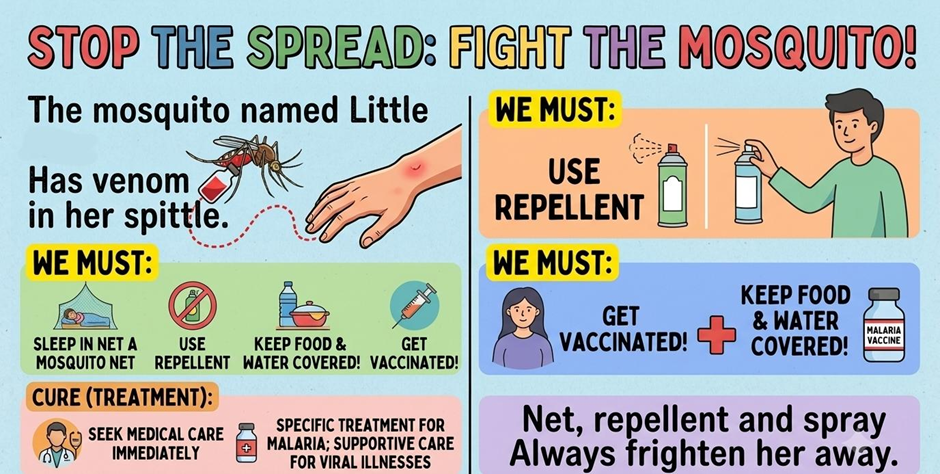
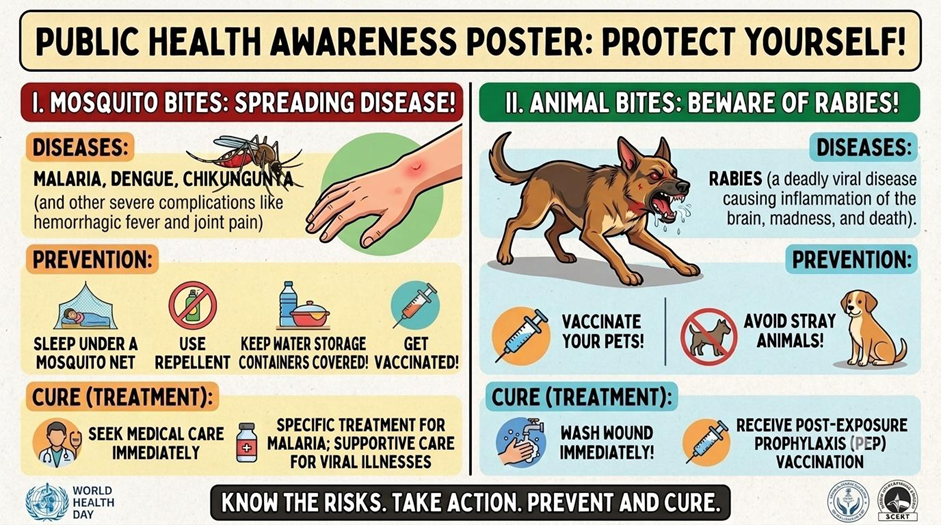
12. Work in groups. Make a poster (using pictures and captions) to create public awareness of what happens when mosquitoes and animals bite. Remember to mention the (i) diseases, (ii) their prevention and (iii) their cure.
Answer:
13.
Answer: Just read by yourself. Not important for exam.
14. Pick out the proverbs from the given list:
Answer:
- All that glitters is not gold.
- Every cloud has a silver lining.
- Early to bed and early to rise makes a man healthy, wealthy and wise.
Now, read the lesson carefully. Then, using the text as the basis, in groups discuss and prepare a speech on the following proverb:
Prevention Is Better Than Cure.
Answer:
Respected Principal, Teachers, and my dear friends,
A very good morning to everyone. Today, I am speaking on the famous health proverb: “Prevention Is Better Than Cure.”
In our lesson, we learned how Louis Pasteur discovered a cure for rabies. While his discovery saved lives, it also reminds us that avoiding a disease is always safer and easier than fighting it.
When we fall sick from animal bites or mosquito-borne diseases like malaria, our body suffers pain and weakness. Vaccines and medicines can cure us, but prevention stops the illness before it even starts.
We can easily protect our health by following simple habits:
- Maintain Hygiene: Wash hands with soap and water regularly.
- Prevent Vector Bites: Sleep under mosquito nets and use repellents.
- Animal Care: Vaccinate pets and avoid touching stray animals.
- Get Vaccinated: Take timely vaccines to build strong immunity.
Cures repair our health, but prevention protects it. Let us practice cleanliness, stay safe, and remember: Prevention is always better than cure.
Thank you!
17. Refer to a dictionary or your text and give two examples of adjectives with the following prefixes or suffixes. (One is done for you.)
Answer:
Prefix: un- (Given as an example)
- Base Words: happy, tidy
- Adjectives: unhappy, untidy
Prefix: dis-
- Base Words: honest, loyal
- Adjectives: dishonest, disloyal
Suffix: -less
- Base Words: care, hope
- Adjectives: careless, hopeless
Suffix: -al
- Base Words: nation, person
- Adjectives: national, personal
Suffix: -ful
- Base Words: use, wonder
- Adjectives: useful, wonderful
Suffix: -ous
- Base Words: danger, fame
- Adjectives: dangerous, famous
Sentences Using Some of These Adjectives
- Unhappy: The boy was unhappy when he lost his favorite toy.
- Dishonest: We should never be dishonest with our parents and teachers.
- Careless: Driving fast on a rainy day is a careless thing to do.
- National: Independence Day is our national festival.
- Useful: Mosquito nets are very useful for preventing insect bites.
- Dangerous: Rabies is a dangerous disease caused by animal bites.
- Famous: Louis Pasteur became famous for discovering the cure for rabies.
18. (a) Recite:
The mosquito named Little
Has venom in her spittle.
Net, repellent and spray
Always frighten her away.
(b) Now, develop a poster based on the poem.
Answer: