English: Class 8 ৰ ইংৰাজীৰ সকলো অধ্যায় পাবলৈ ইয়াত ক্লিক কৰক।
Lesson 4: Dokchory Learns About The Panchayat
Activities
Q.1. Here are some words from the text and their meanings. Test your understanding by matching the words on the left with their meanings by matching the words on the left with meanings on the right.
Answer:
| Words | Meanings |
|---|---|
| (i) institution | organisation or society. |
| (ii) elections | the exercise through which we vote for new leaders. |
| (iii) sincerity | devotion to a purpose. |
| (iv) differently-abled | having a physical or mental condition that makes it difficult for a person to do all the work that other people do. |
| (v) schemes | plans. |
| (vi) substantial | large in size or amount. |
| (vii) rural | relating to village or the countryside. |
| (viii) tax | The money citizens of a country have to pay the government to help it do different kinds of work. |
| (ix) quarrel | angry dispute, unfriendly relations with someone. |
| (x) governance | manner of governing or ruling. |
Q.2. Complete the following sentences with information from the text.
Answer:
(a) Dokchory studies in Class Eight.
(b) The name of her school is Disangmukh Janajati High School.
(c) Her father’s name is Konke Mili.
(d) He works in the Panchayat Office.
(e) Dokchory goes to school on father’s bicycle.
(f) She loves the ride because she gets to know new things every day.
(g) To contest the Panchayat elections, one has to be above twenty-one years old.
Q.3. Answer the following questions to understand the text better.
(a) What was the meaning of Panchayat long ago?
Answer: Long ago, Panchayat meant a ruling system of five village elders called Panch Gramin Pramukh.
(b) What is the meaning of Panchayat Now?
Answer: Now, Panchayat is the body that is responsible for the development of villages.
(c) What kind of work is done by the Panchayat?
Answer: The Panchayat builds and repairs rural roads, bridges, and houses for poor people. It works for overall village growth and social change.
(d) From where does the panchayat get money to perform all its work?
Answer: The Panchayat gets money from local taxes on vehicles, markets, and rivers. It also receives an annual fund from the government’s development department.
(e) How did the Panchayat help Dhaniram?
Answer: The Panchayat helped Dhaniram by building a house for him.
(f) How did Dhaniram spend the cold December nights?
Answer: Dhaniram spent the cold December nights sleeping outside on the open verandah of the school building.
4. You have just read about the panchayat. Using information from the lesson, fill in the table below:
Answer:
| Particulars | Details |
|---|---|
| Minimum Age to Contest | 21 Years. |
| Powers of a Panchayat | Granted by the Constitution of India to raise taxes, plan development schemes, and work for local development. |
| Kind of work Panchayat does | Builds and repairs rural roads, bridges, houses for the poor, and homes for people with special needs. |
| Sources of Money | Taxes on vehicles, river ghats, bazaars, and beels, along with an annual grant from the government’s Panchayat and Rural Development Department. |
5. Imagine that your turn to deliver a speech for the morning assembly is tomorrow. Prepare your own speech using Dokchory’s example, and present it in the class.
Answer: Good morning! Respected Principal, teachers, parents, and my dear friends. I am (Student’s Name). Today I am going to talk about the importance of saving trees in our environment. Trees are often called the green lungs of our planet because they provide us with the oxygen we breathe and clean the air. They give us shade, delicious fruits, and shelter to birds and animals. Without trees, our beautiful Earth would turn into a lifeless desert, and we would face severe climate problems like heavy floods. Therefore, we should all take a pledge to plant more trees and protect them to make our world a better and greener place. Thank you!
6. Discuss in small groups:
(a) If you want to help the needy, would it be fine to do it immediately? Why or why not?
Answer: Yes, it is always a wonderful idea to help a needy person immediately if they are in an urgent or dangerous situation, such as needing food, medical attention, or shelter from freezing weather. However, for long-term support, it is important to pause and understand their actual situation first so that we can provide the right kind of help that genuinely solves their problem rather than giving a temporary fix.
(b) How would you like to help a person with special needs? Share your ideas in your group.
Answer: I would love to help a person with special needs by spending quality time with them, talking to them, and treating them with equal respect so they never feel lonely. Professionally and practically, I can help them by teaching them new skills like drawing, reading, or crafts, assisting them with their daily chores if they face difficulties, and encouraging them to become self-reliant and independent in life.
(c) Did Konke Mili plan the right thing to help Dhaniram? Give more suggestions.
Answer: Yes, Konke Mili planned the perfect thing by building a special home where people with special needs like Dhaniram can live with dignity and safety. To make this plan even better, the Panchayat can arrange for a permanent caregiver to help with daily chores, set up a small medical center inside the home, and provide simple vocational training so the residents can learn to make crafts and earn their own living.
7. Dokchory will work for the Panchayat when she finishes school. Write a paragraph on what you will do for your village or town when you grow up.
Answer: When I grow up, I want to work dedicatedly for the development and welfare of my village. My primary focus will be on improving the local education system by building modern libraries and ensuring that poor children have access to free books and study materials. I also want to work closely with the local authorities to repair broken roads, plant more trees to protect our environment from erosion, and set up proper medical camps for elderly and differently-abled people. By doing these things, I hope to make my village a cleaner, healthier, and much better place for everyone to live happily.
8. Let’s practise changing other questions into the reported form:
(a) She said to her father, “What kind of work do you do?”
Ans:- She asked her father what kind of work he did.
(b) She said to her father, “Where do you get all the money from?”
Ans:- She asked her father where he got all the money from.
(c) She said to her father, “Is that enough to do so much work?”
Ans:- She asked her father if that was enough to do so much work.
(d) She asked him, “Why don’t you build a house for poor Dhaniram?”
Ans:- She asked him why he didn’t build a house for poor Dhaniram.
(e) She said to him, “What is a Panchayat?”
Ans:- She asked him what a Panchayat was.
Find out how much you have understood. Change the following imperative sentences into their negative and emphatic forms:
(a) Repair the roads.
Answer:
Negative: Don’t repair the roads.
Emphatic: Do repair the roads.
(b) Build a house for Dhaniram.
Answer:
Negative: Don’t build a house for Dhaniram.
Emphatic: Do build a house for Dhaniram.
(c) Work for local development.
Answer:
Negative: Don’t work for local development.
Emphatic: Do work for local development.
(d) Close the door, please.
Answer:
Negative: Don’t close the door, please.
Emphatic: Do close the door, please.
(e) Please wash your hands.
Answer:
Negative: Please don’t wash your hands.
Emphatic: Do please wash your hands.
9. Now, find other words from the lesson which have similar ch sound in them. Write them in your notebook.
Answer:
- Each
- Teacher
- Chores
- Which
10.
Answer: Do by yourself ( not important for exam as it is a puzzle game )
11.
Answer: Do by yourself ( not important for exam as it is a puzzle game )
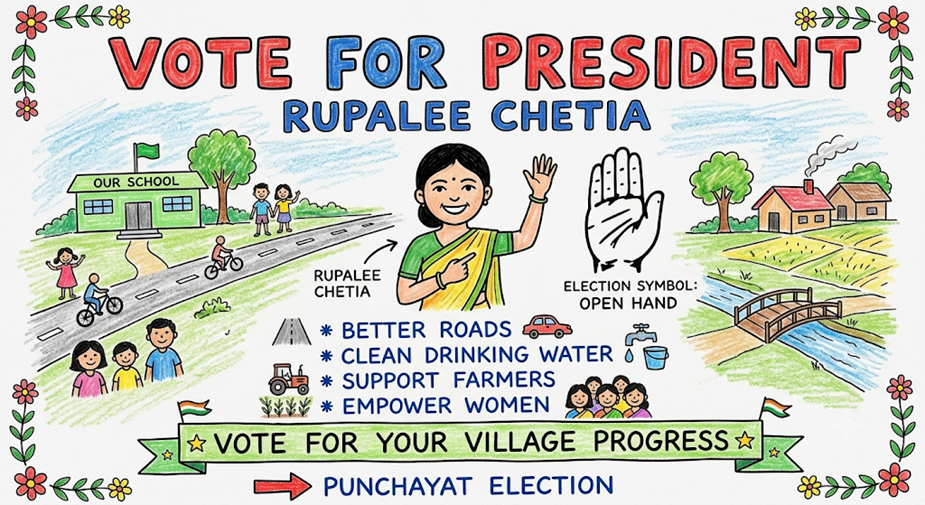
12. Rupalee Chetia is a contestant for President in the coming Panchay election. In groups, design a poster seeking votes for her victory.
Amswer:
14. Think and write: Do you love your country? Discuss with your friend how you can show your love for your country. Write a paragraph on it.
Answer: Yes, I love my country deeply, and I believe that showing love for our nation does not only mean standing up during the national anthem or cheering during sports events. We can show true patriotism in our daily lives by being responsible citizens, keeping our local surroundings clean, and avoiding the wastage of water and electricity. As a student, my primary duty is to study hard so that I can use my knowledge to solve societal problems like environmental issues, floods, and poverty when I grow up. By respecting our laws, helping fellow citizens who are in need, and working honestly, we can collectively contribute to the progress, peace, and honor of our nation.
